Guide
Miele Dishwasher Care Tips for Harrison Kitchens
A practical upkeep routine for panel-ready Miele dishwashers in Harrison, NY — filters, spray arms, salt and rinse aid, door drying, and the faults worth a service call.
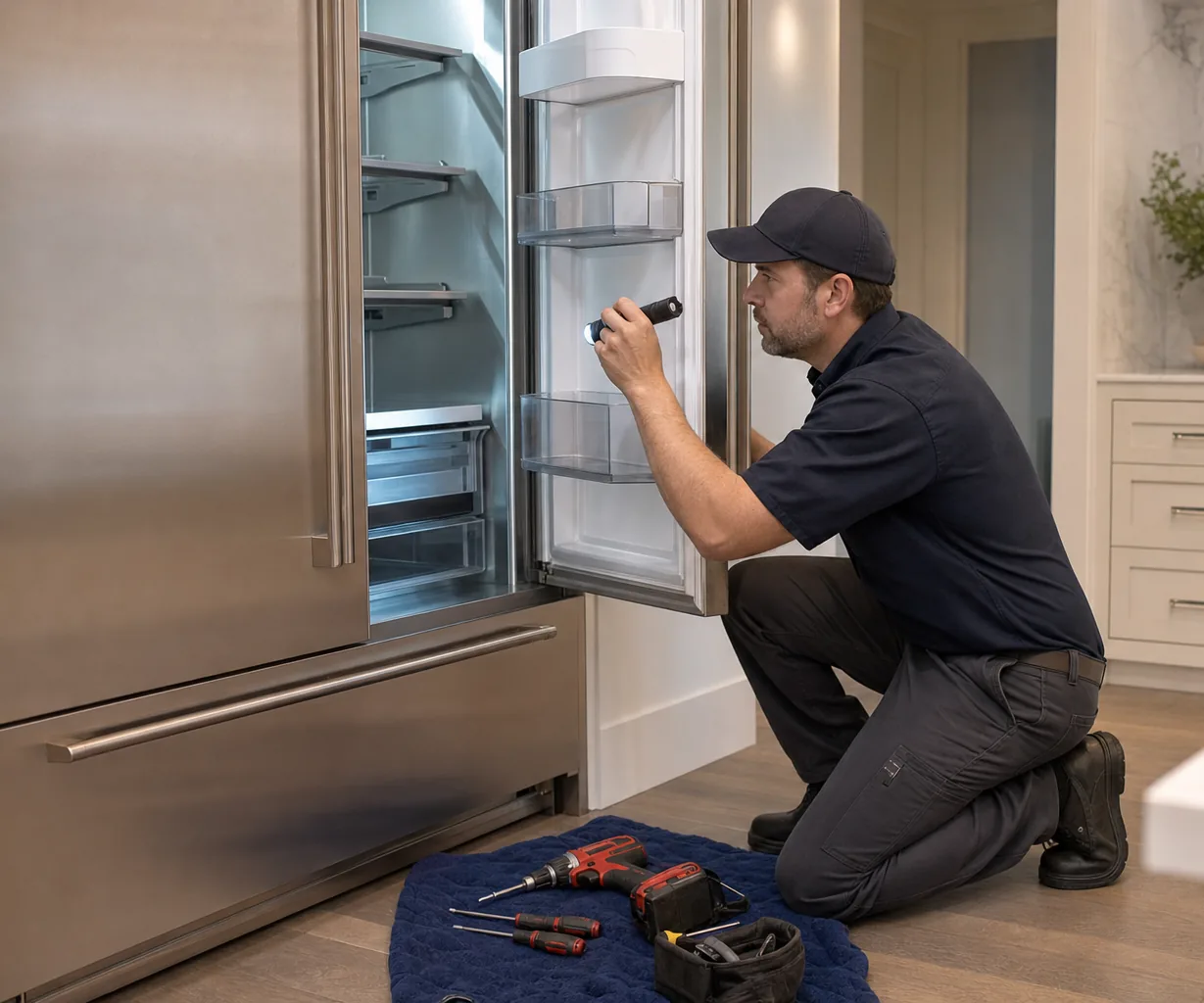
A Miele dishwasher rarely fails loudly. It runs a long, quiet cycle behind a cabinet panel, and by the time a Harrison homeowner notices cloudy glassware or a film on the cutlery, the machine has usually been asking for maintenance for months. Almost everything below is a ten-minute chore you can do yourself; the last section is the short list of faults that are ours, not yours.
Start at the filter, because that is where most complaints end
Miele uses a three-part filter assembly in the sump: a coarse catch, a flat fine filter and a microfine cylinder that twists out counter-clockwise. Pull the lower basket, lift the assembly out as one piece, separate it and rinse everything under warm running water with a soft brush. Grease is the real enemy — a filter that looks clean can still be glazed with a film that slows drainage and pushes soil back onto the top rack.
How often depends on how you load. A household that scrapes plates hard and runs the machine daily can go a month. A kitchen that rinses nothing, or that runs a lot of roasting pans and dairy, wants a look every week or two. If you have never taken yours apart, take it apart today — a decade of “it seems fine” is the single most common reason a Miele stops cleaning the upper basket.
Spray arms, the cutlery tray and the intake
With the filter out, spin both spray arms by hand. They should turn freely and silently. Hold each one up to the light and check the jets: a blocked hole is usually a seed, a splinter of glass or a chip of label paper, and it comes out with a toothpick. On models with the flat third-level cutlery tray, the tray has its own small jets — they clog first, because nothing on that level shields them.
The water intake has a fine screen where the hose meets the valve. It is not a routine chore and it does involve shutting off the supply, so if your cycles have started taking noticeably longer to fill, leave that one to a technician rather than working over a finished floor.
Salt, rinse aid and the detergent question
Miele’s built-in water softener has its own reservoir in the floor of the tub, and it takes reactivation salt only — never dishwasher detergent, never table salt, and nothing goes in that cap except the salt and the water it displaces. Fill it with the basket out, wipe up any spill immediately, and run a short cycle so loose grains do not sit against stainless.
Much of the Harrison, West Harrison and Silver Lake supply is soft aqueduct water, so a softener setting cranked up out of habit will chew through salt for no benefit and can leave a salty taste on glass. If your property draws from a private well instead, the opposite is true and the setting needs to reflect that. Rinse aid is the other half: set it low and glassware dries with spots, set it high and you get a slick film, and the dial exists precisely because the right number is a property-by-property answer.
On the newer machines with the twist-in detergent disc, the disc is a convenience, not a requirement — the dispenser flap still takes ordinary powder or a tablet if you would rather. What matters either way is that the flap can open: a tall platter leaned against it is a cycle that washes with no detergent at all.
The door, the seal and the drying you should not interrupt
Wipe the gasket and the lip below the door every couple of weeks. That lip collects a dark grey sludge that nothing in the cycle ever reaches, and it is the source of most “my dishwasher smells” calls.
Machines that pop the door open at the end of the program are drying with room air on purpose. Pushing that door closed because it is in the way of the island traffic, or because the panel looks untidy, traps the moisture you just spent an hour driving off. Give it half an hour. On handleless panel-ready units that open to a knock, a door that no longer responds is a latch or drive issue, not a technique problem — it is not something to force.
A rhythm that keeps it out of the repair queue
- Every load: scrape solids, check the detergent flap is clear, do not block the upper arm with a tall pot.
- Every week or two: rinse the three filters, wipe the door lip and gasket.
- Every month: spin and inspect both spray arms and the cutlery-tray jets; check the salt indicator.
- Every season: run an empty hot program with a dishwasher cleaner; look under the front toe-kick for any staining that suggests a slow weep.
- Once a year: look hard at the finished floor in front of the machine and at the cabinet side panels beside it. Integrated dishwashers in the older Downtown Harrison houses sit tight in cabinetry with wood underfoot, and a slow weep stays invisible until a plank cups.
When the display is talking, listen to the subsystem
Miele fault codes point at a subsystem, not at a specific part: water in, water out, heating, or the leak-protection system that shuts the supply off on its own. That distinction is the useful part. A machine that will not drain and is holding standing water, a machine that trips its own water protection, a heater that has stopped so the load comes out cold and wet, or a latch that no longer holds the door — these are diagnosis jobs, and guessing at parts on a Miele is an expensive way to be wrong.
Standing water is also the one situation worth handling immediately rather than at the weekend. Turn the machine off at the breaker if you are unsure, and do not keep starting cycles to see whether it clears.
What a repair visit looks like here
We work on Miele alongside the rest of the built-in kitchen — see Miele repair, dishwasher repair and built-in dishwashers for what that covers. The diagnostic visit is $95 and it is credited toward the repair; most dishwasher jobs land in the $200–$600 range all in, with the firm number given on site once the fault is identified, and every repair carries a 1-year parts and labor warranty. Same-day service is available in most cases across Harrison, and there is emergency cover around the clock when water is where it should not be. Full ranges are on the pricing page.
Call (475) 471-0742 or book a visit online. We are an independent repair company and not manufacturer-authorized.